

News
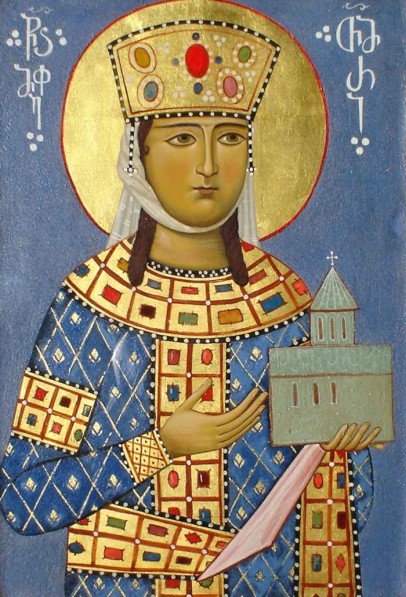
St. Tamara, Queen of Georgia
14/05/2015
On May 1 (14) (also on the Sunday of the Myrrhbearing Women) Georgian Orthodox Church commemorates St. Tamara, the Great Queen of Georgia.
Tamar Bagrationi was Queen of the kingdom of Georgia from 1184-1213. She ruled during what is generally regarded as Georgias "golden age" and gained a reputation as an outstandingly successful ruler, dubbed "King of Kings and Queen of Queens" by her subjects.
She was born in 1160, the daughter of King Giorgi III (1156-1184) and Queen Burdukhan of Georgia. The king proclaimed that he would share the throne with his daughter from the day she turned twelve. The father and daughter ruled the country together for five years. After King Georges death in 1184, Queen Tamara was enthroned as ruler of all Georgia at the age of eighteen. She is called “King” in the Georgian language because her father had no male heir and so she ruled as a monarch and not as a consort.
She was a pious individual, an after her coronation, she convoked a local council to correct problems in church life. When the bishops had assembled from all parts of her kingdom, she called upon them to establish righteousness and stop any abuses.
Tamars first husband was the Russian prince Yuri (known in Georgia as Giorgi) Bogolyubski (in 1185-1186). She had no children by Yuri. His marriage to Tamara exposed many of the coarser sides of his character. He was often drunk and inclined toward immoral deeds. In the end, Tamars court banished him to Constantinople, along with a generous allowance. Then she selected her second husband herself. He was the Ossetian prince David Soslan of the Georgian Bagrationi family, whom she married in 1188.
Tamar played an active military role as the commander of an army. In 1193 the Georgian army marched to Bardav. Following its triumphant return, a new campaign was undertaken against Erzerum. The army under Tamar and David attacked the Seljuks (Turks) wintering on the banks of the river Arax.
The Atabag of Azerbaijan Abu-Bakr was given command of the army of the coalition of Georgias Muslim opponents. A battle was fought near Shamkhor in 1195 which ended in a Georgian victory. Numerous prisoners and huge amounts of booty were seized, including the Khalifs standard, which Tamar donated to the Icon of Our Lady of Khakhuli. The Georgians took the city of Shamkhori and the adjoining regions, and the occupied lands were turned over to the Shirvan-Shah on terms of vassalage. From Shamkhori the Georgian army marched to Gandza.
The Georgian victories alarmed the Muslim rulers of Georgias neighbours, particularly Rukn ad-Din, Sultan of the Seljuk state in Asia Minor. The Sultan prepared for war in order to break the might of Christian Georgia and fought a major battle near Basiani in 1203. Despite the huge size of the Seljuk army - said to number more than 400,000 troops - the Georgian army under Tamar and David won a famous victory.
Under Tamars rule, Georgia became the strongest power in the Near East and expanded its territorial influence considerably around the shores of the Black Sea. In 1204, Tamar became the main founder of the Kingdom of Trabizond on the southern shore of the Black Sea (now the Turkish province of Trabzon). This Kingdom was populated mainly by Lazi (Chani) Georgian tribes. In 1206, Tamars army occupied the city of Kars.
Like other medieval monarchs, Tamar played an active role in promoting her countrys religion and culture, sponsoring the construction of numerous Georgian Orthodox churches. The poet Shota Rustaveli commemorated Tamar in his epic poem The Knight in the Panthers Skin, in which her coronation gave Rustaveli the historical background for his sublime description of the coronation of Tinatin.
Queen Tamara carried out a regular, secret observance of a strict ascetic regime – fasting, a stone bed, and litanies chanted in bare feet, which finally took a toll on her health. The queen died in 1213 and was subsequently canonized by the Georgian Orthodox and Apostolic Church. The burial place of Queen Tamara has remained a mystery to this day. Some sources claim that her tomb is in Gelati, in a branch of burial vaults belonging to the Bagrationi dynasty, while others argue that her holy relics are preserved in a vault at the Holy Cross Monastery in Jerusalem.
Other News
-
29/09/2016
SKYE Clubs
-
01/06/2016
“INTELLECTUAL AND SPIRITUAL DEVELOPMENT OF YOUTH” May – 2016
-
01/06/2016
MEDIATION – CONFLICT RESOLUTION (INCLUDING RELIGIOUS) THROUGH NEGOTIATION May - 2016
-
30/04/2016
Mediation – conflict resolution (including religious) through negotiation
-
30/04/2016
“Intellectual and spiritual development of Youth”
-
07/04/2016
The litugry of Annunciation
-
07/04/2016
Let’s beg the Lord that the day of Annuciation would be happy and peaceful.