

News
Sunday of the Last Judgment
16/02/2014
The Sunday of the Last Judgment is the third Sunday of a three-week period prior to the commencement of Great Lent. During this time, the services of the Church have begun to include hymns from the Triodion, a liturgical book that contains the services from the Sunday of the Publican and the Pharisee, the tenth before Pascha (Easter), through Great and Holy Saturday. On this day, focus is placed on the future judgment of all persons who will stand before the throne of God when Christ returns in His glory.
Biblical Story
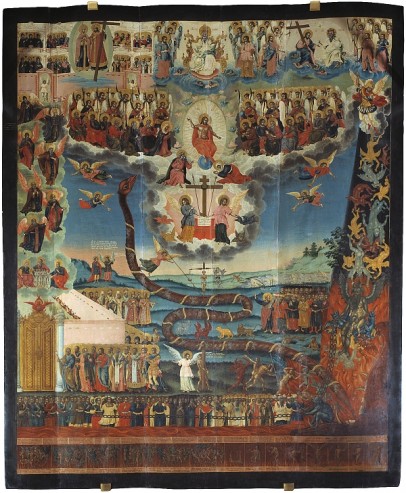
The commemoration for this Sunday is taken from the parable of our Lord Jesus Christ concerning his Second Coming and the Last Judgment of all, both the living and the dead. In Matthew 25:31-46, Christ speaks about what will happen at this specific point in time when He will “come in His glory, and all the holy angels with Him” (v. 31).
At His coming, “He will sit on the throne of His glory,” and all of the nations will be gathered before Him. He will separate them “as a shepherd divides his sheep from the goats” (v. 32). The sheep will be placed on His right hand, and the goats on the left.
To the sheep, He will say “Come, you blessed of My Father, inherit the kingdom prepared for you from the foundation of the world” (vv. 33-34)
This kingdom is offered to the sheep because of their compassion and service to those in need. Jesus says, “…for I was hungry and you gave Me food; I was thirsty and you gave Me drink; I was a stranger and you took Me in; I was naked and you clothed Me; I was sick and you visited Me; I was in prison and you came to Me.”
The sheep, who are the righteous chosen for the kingdom, will ask how this could be so. They will ask Jesus when was He hungry or thirsty, a stranger, naked, and in prison. He will answer them by saying, “Assuredly, I say to you, inasmuch as you did it to the least of these My brethren, you did it to me” (vv. 35-40).
Christ the King, seated on His throne of judgment, will then turn to the goats on His left and say, “Depart from Me, you cursed, into the everlasting fire prepared for the devil and his angels” (v. 41). He will condemn them because they did not feed Him when He was hungry, give Him drink when He was thirsty, take Him in when He was a stranger, clothe Him when He was naked, visit Him when He was sick or in prison.
The goats will ask the Lord, “When did we see You hungry or thirsty or a stranger or naked or sick or in prison, and did not minister to You?” Then He will answer them saying, “Assuredly, I say to you, inasmuch as you did not do it to one of the least of these, you did not do it to me” (vv. 42-45).
Jesus concludes His words on the Last Judgment by stating that those on the left “will go away into everlasting punishment, but the righteous into eternal life” (v. 46).
On the past two Sundays of this pre-Lenten period, the focus was placed on God’s patience and limitless compassion, of His readiness to accept every sinner who returns to Him. On this third Sunday, we are powerfully reminded of a complementary truth: no one is so patient and so merciful as God, but even He does not forgive those who do not repent. The God of love is also a God of righteousness, and when Christ comes again in glory, He will come as our Judge. Such is the message of Lent to each of us: turn back while there is still time, repent before the End comes.
This Sunday sets before us the eschatological dimension of Lent: the Great Fast is a preparation for the Second Coming of the Savior, for the eternal Passover in the Age to Come, a theme that is also the focus of the first three days of Holy Week. But the judgment is not only in the future. Here and now, each day and each hour, in hardening our hearts toward others and in failing to respond to the opportunities we are given of helping them, we are already passing judgment on ourselves.
Another theme of this Sunday is that of love. When Christ comes to judge us, what will be the criterion of His judgment? The parable of the Last Judgment answers: love—not a mere humanitarian concern for abstract justice and the anonymous “poor,” but concrete and personal love for the human person—the specific persons that we encounter each day in our lives.
Christian love is the “possible impossibility” to see Christ in another person, whoever he or she is, and whom God, in His eternal and mysterious plan, has decided to introduce into my life, be it only for a few moments, not as an occasion for a “good deed” or an exercise in philanthropy, but as the beginning of an eternal companionship in God Himself.
The parable of the Last Judgment is about Christian love. Not all of us are called to work for “humanity,” yet each one of us has received the gift and the grace of Christ’s love. We know that all persons ultimately need this personal love—the recognition in them of their unique soul in which the beauty of the whole creation is reflected in a unique way. We also know that people are in prison and are sick and thirsty and hungry because that personal love has been denied them. And, finally, we know that however narrow and limited the framework of our personal existence, each one of us has been made responsible for a tiny part of the Kingdom of God, made responsible by that very gift of Christ’s love. Thus, on whether or not we have accepted this responsibility, on whether we have loved or refused to love, shall we be judged.
Orthodox Christian Celebration Of The Feast Of The Last Judgement
The Sunday of the Last Judgment is commemorated with the Divine Liturgy of Saint John Chrysostom, which is preceded by the Matins service. A Great Vespers is conducted on Saturday evening. The hymns of the Triodion for this day are added to the usual prayers and hymns of the weekly commemoration of the Resurrection of Christ. The naming of the Sunday is related to the reading of the story from the Gospel at the Divine Liturgy.
Scripture readings for the Sunday of the Last Judgment are: At the Orthros (Matins): The prescribed weekly Gospel reading. At the Divine Liturgy: I Corinthians 8:8-9:2; Matthew 25:31-46.
The Sunday of the Last Judgment is also known as Meatfare Sunday. This is the last day that meat can be eaten before the Lenten fast. Dairy products are allowed on each day of this week, even Wednesday and Friday. The next Sunday is the Sunday of Cheesefare, It is the last day that dairy products can be eaten prior to the commencement of Great Lent.
On the Saturday before this Sunday, the first of three Saturdays of the Souls are held. This is a special commemoration on this and the next two Saturdays, when the Church offers a Divine Liturgy and Memorial Service for the departed faithful. This is considered a universal commemoration of the dead. It is closely related to the theme of the Sunday of the Last Judgment since the services focus on the Second Coming of Christ and the resurrection of the dead. Through the memorial services, the Church is commending to God all who have departed and who are now awaiting the Last Judgment.
Other News
-
29/09/2016
SKYE Clubs
-
01/06/2016
“INTELLECTUAL AND SPIRITUAL DEVELOPMENT OF YOUTH” May – 2016
-
01/06/2016
MEDIATION – CONFLICT RESOLUTION (INCLUDING RELIGIOUS) THROUGH NEGOTIATION May - 2016
-
30/04/2016
Mediation – conflict resolution (including religious) through negotiation
-
30/04/2016
“Intellectual and spiritual development of Youth”
-
07/04/2016
The litugry of Annunciation
-
07/04/2016
Let’s beg the Lord that the day of Annuciation would be happy and peaceful.