


News
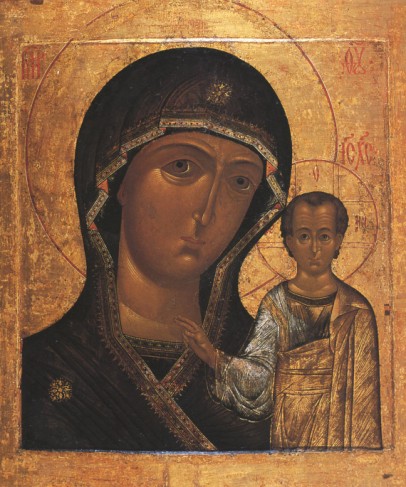
The Icon of Our Lady of Kazan
21/07/2013
On July 21 (July 8) is celebrated the phenomenon of the icon of Our Lady in the city of Kazan.
Our Lady of Kazan is an icon of the Theotokos popular in Russia since the 16th century. A close-up variant of the Hodegetria (Directress) style, it is noted mainly for the Child standing, with the Virgin chest-length. The Kazan icons are traditionally small, following the original (9×11 inches). The Kazan icon of the Virgin remains popular, especially as a wedding gift.
The image of Our Lady of Kazan is said to have come to Russia from Constantinople in the 13th century. After the Tatars besieged Kazan and made it the capital of their khanate in 1438, the icon disappeared, and it is not mentioned again until the 16th century, some years after the liberation of Kazan by Ivan the Terrible in 1552.
After a fire destroyed Kazan in 1579, the Virgin appeared in a prophetic dream to a 10-year-old girl named Matrona and told her where to find the precious image again. As instructed, Matrona told the archbishop about her dream, but he would not take her seriously. After two more such dreams, on July 8, 1579, the girl and her mother themselves dug up the image, buried under the ashes of a house, where it had been hidden long before to save it from the Tatars. The unearthed icon looked as bright and beautiful as if it were new. The archbishop repented of his unbelief and took the icon to the Church of St. Nicholas, where a blind man was cured that very day. Hermogen, the priest at this church, later became Metropolitan of Kazan. He brought the icon to Kazan's Cathedral of the Annunciation and established July 8 as a feast in honor of the Theotokos of Kazan. It is from Hermogen's chronicle, written at the request of the tsar in 1595 that we know of these events.
By 1612, when Moscow was occupied by Polish invaders, Hermogen had become Patriarch of Moscow and All Russia. From prison, he called for a three-day fast and ordered the icon of Our Lady of Kazan to be brought to Princes Minin and Pozharsky, who were leading the resistance to the occupation. This icon—possibly the original, but more likely a copy—was carried before their regiments as they fought to regain the capital from the Poles. When the Polish army was finally driven from Moscow on October 22, 1612, the victory was attributed to the intercession of the Mother of God, and the Kazan icon became a focal point for Russian national sentiments. Later that year, when Tsar Mikhail Feodorovich came to the throne, he appointed both July 8 and October 22 as feasts in honor of Our Lady of Kazan.
The victorious Prince Dmitry Pozharsky financed the construction of a small wooden church dedicated to the Virgin of Kazan in the Moscow Kremlin. The icon was kept there until the small church burnt down in 1632. The tsar ordered the construction of a larger brick cathedral to replace it. After its completion in 1638, the icon remained there in Moscow's Kazan Cathedral for nearly two centuries. It was regularly borne in solemn liturgical processions along the city walls as the protectress of Moscow. The intercession of Our Lady of Kazan was successfully invoked against a Swedish invasion in 1709, and again when Napoleon invaded Russia in 1812. To commemorate this latter victory, the Kazan icon was moved to the new Kazan Cathedral in St. Petersburg in 1821.
By this time, the Kazan icon had achieved immense popularity, and there were nine or ten separate miracle-working copies of the icon around the country. There is considerable disagreement about which of these, if any, was the original. Some claim the original remained housed in Kazan, while others hold that the one moved from Moscow to St. Petersburg was the original. Many experts, however, believe the original was lost and both of the venerated Kazan icons were early copies. In any case, both icons disappeared in the early 20th century. The one in Kazan was stolen in 1904 and probably destroyed by the thieves, who were more interested in its jeweled gold covering. The one in St. Petersburg disappeared after the October Revolution of 1917. Some say it was smuggled out of the country to protect it from the Bolsheviks, while others suggest the Communists themselves hid it and later sold it abroad. But during World War II, an icon of the Virgin of Kazan surfaced in Leningrad to lead a procession around the fortifications of the Nazi-besieged city.
The wonderworking icons Our Lady of Sitka and Our Lady of Soufanieh are both of the Kazan type.
Troparion: O fervent intercessor, Mother of the Lord Most High, thou dost pray to thy Son Christ our God and savest all who seek thy protection. O Sovereign Lady and Queen, help and defend all of us who in trouble and trials, in pain and burdened with sins, stand in thy presence before thine icon, and who pray with compunction, contrition, and tears and with unflagging hope in thee. Grant what is good for us, deliverance from evil, and save us all, O Virgin Mother of God, for thou art a divine protection to thy servants.
Kontakion: O peoples, let us run to that quiet good haven, to the speedy helper, the warm salvation, to the Virgin's protection. Let us speed to prayer and hasten to repentance. For the Mother of God pours out her mercy, anticipates needs, and averts disasters for her patient and God-fearing servants.
Other News
-
29/09/2016
SKYE Clubs
-
01/06/2016
MEDIATION – CONFLICT RESOLUTION (INCLUDING RELIGIOUS) THROUGH NEGOTIATION May - 2016
-
01/06/2016
“INTELLECTUAL AND SPIRITUAL DEVELOPMENT OF YOUTH” May – 2016
-
30/04/2016
“Intellectual and spiritual development of Youth”
-
30/04/2016
Mediation – conflict resolution (including religious) through negotiation
-
07/04/2016
Let’s beg the Lord that the day of Annuciation would be happy and peaceful.
-
07/04/2016
The litugry of Annunciation