

News
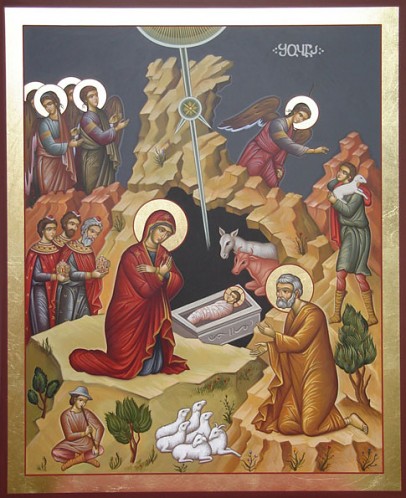
The Nativity of our Lord and Savior Jesus Christ
07/01/2013
On January 7 (December 25 by Julian calendar) the Orthodox Church celebrates the Feast of the Nativity of our Lord and Savior Jesus Christ.
The Feast of the Nativity of Jesus is one of the most joyful days of the Orthodox Church. It ranks next to the greatest holiday, the Resurrection ofJesus. The Feast of the Birth ofJesus is also known as the "Incarnation of Christ." This means that Jesus became a man and came into the world to save us. We also refer to this joyous feast as Christmas.
The story of the Nativity ofChrist is beautifully told in the Holy Scriptures. The story is found in Matthew 1:18-25 and in Luke 2:1-20. No matter howoften the Birth of Jesus is told, we realize that it is an important event.
As the story is told by the Apostles, the Roman Empire was powerful. The Romans had conquered much of the then known world. Judea and Samaria, what we know today as Israel, were included in their conquests. Emperor Augustus ordered that a census be taken in all his lands. He needed to know how many people lived in the empire so he could tax them. Everyone had to go to the town of their family's origin to register for the census. This meant that Mary and Joseph had to go to Bethlehem. They were descendants ofKing David and Bethlehem was the City of David.
Mary and Joseph lived in Nazareth and it was a great distance from Bethlehem. It was about 100 miles over very rugged roads. Moreover, Mary was expecting the baby and it was almost time for her to give birth. Bethlehem was a small town and there were many descendants of David who had come to register for the census. By the time Mary and Joseph arrived in Bethlehem there was no place for them to stay. Joseph tried very hard to find a place to sleep that evening. There was no room at the inn. Finally, Joseph found a cave-like place where they could rest. This place was used by shepherds to protect their sheep in stormy weather. It was here that Mary gave birth to Jesus. The baby was wrapped in swaddling clothes and laid in the straw in the manger.
Now, that night the shepherds were out in the fields guarding their sheep. Suddenly, there was a bright light which startled the shepherds. The light was so bright that it turned the night into daylight. Of course, the shepherds were frightened. Nothing such as this had ever happened. Soon an angel appeared and calmed them. The angel said:
"Fear not for behold, I bring you good tidings of great joy, which shall be to all people. For unto you is born this day in the city ofDavid a Savior; which is Christ the Lord. And this shall be a sign unto you: You shall find the babe wrapped in swaddling clothes, lying in a manger" (Luke 2:11-12).
Then a larger group of angels appeared. They praised and glorified God and sang, "Glory to God in the highest, and on earth peace, and good will toward men" (Luke 2:14). When the angels finished singing, they disappeared and the light began to fade. It became dimmer and dimmer until it was dark again. The shepherds were awed. They didn't know what to do. Finally, they decided to leave their flocks of sheep and go to Bethlehem. They decided that they wanted to see for themselves what the angels had told them. When they got to Bethlehem, they found Mary, Joseph, and the infant Jesus. They fell to their knees and adored Jesus.
Some Wise Men came from the East for they knew of the coming of Jesus. They had seen a star that told them that a new king had been born to the Jews. They followed the star and were looking for the child. At this time the governor of Judea was King Herod. He was a wicked man and was feared and hated by the people. When Herod heard about the Wise Men looking for the child, he invited them to his palace. Herod asked the Wise Men to find the child so that he, too, could worship Him. But Herod was lying. He did not want anyone to take his place. The Wise Men went on to look for Jesus. The Star led them to Jesus and Mary. When the Wise Men found Jesus, they fell to their knees and worshipped Him. They gave Jesus gifts of gold, frankincense, and myrrh. The Wise Men left but did not return to Herod. They had a dream that warned them that Herod wanted to harm Jesus. Instead, they returned to their native country by a different route.
The Orthodox celebration of the Feast of the Nativity
As with Pascha, or Easter, the Feast of the Nativity begins with a period ofpreparation. It is preceded by a fast corresponding to Lent and lasting for forty days. The fast begins on November 15.
On the Sundays immediately before December 25, special commemorations emphasize the link between the Old Covenant and the New. On December 20 the Forefeast of the Nativity is commemorated, and the daily liturgical texts are directed toward the Feast itself. On Christmas Eve, services include the Great or Royal Hours, the Great Vespers, and the Liturgy of Saint Basil.
On Christmas Day the service commemorates the birth of Christ in Bethlehem, the adoration of the Shepherds, and the arrival of the Wise Men with their gifts. The service held on this day is the Liturgy of Saint John Chrysostom.
The days following Christmas are associated with the Theotokos and Joseph. December 26 is the Synaxis of the Mother of God, and the first Sunday after the Feast commemorates “Joseph the Betrothed.” December 29 commemorates the Massacre of the Innocents, and January 1 the Circumcision of our Lord. The Nativity season concludes on December 31, but the spirit of the festival extends to the celebration of Theophany (Epiphany), the feast commemorating the Baptism of our Lord in the Jordan River.
Other News
-
29/09/2016
SKYE Clubs
-
01/06/2016
“INTELLECTUAL AND SPIRITUAL DEVELOPMENT OF YOUTH” May – 2016
-
01/06/2016
MEDIATION – CONFLICT RESOLUTION (INCLUDING RELIGIOUS) THROUGH NEGOTIATION May - 2016
-
30/04/2016
“Intellectual and spiritual development of Youth”
-
30/04/2016
Mediation – conflict resolution (including religious) through negotiation
-
07/04/2016
Let’s beg the Lord that the day of Annuciation would be happy and peaceful.
-
07/04/2016
The litugry of Annunciation