

News
The Day of 12 Apostles and the Svetitskhoveli Cathedral
13/07/2012
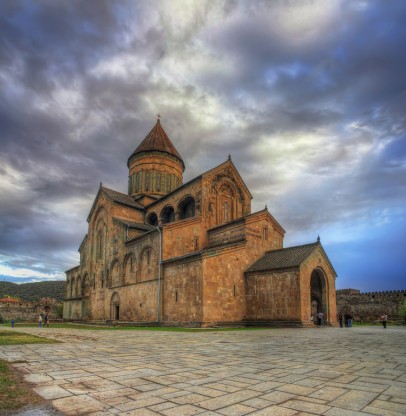
Today the Georgian Orthodox Church celebrates the day of the 12 Apostles of Jesus Christ and the day of Svetitskhoveli Cathedral.
Svetitskhoveli Cathedral is a Georgian Orthodox cathedral located in the historical town of Mtskheta, Georgia, 20 km north-west from the capital of Georgia - Tbilisi.
Svetitskhoveli, known as the burial site of Christ's mantle, has long been the principal Georgian church and remains one of the most venerated places of worship to this day. It presently functions as the seat of the archbishop of Mtskheta and Tbilisi, who is at the same time Catholicos-Patriarch of All Georgia.
The current cathedral was built in the 11th century by the Georgian architect Arsukidze, though the site itself is even older dating back to the early 4th century and is surrounded by a number of legends associated primarily with the early Christian traditions.
It is the second largest church building in the country, after the recently consecrated Tbilisi Holy Trinity Cathedral, and is listed as an UNESCO World Heritage Site along with other historical monuments of Mtskheta.
The original church was built in 4th century A.D. during the reign of Mirian III of Kartli (Iberia). St. Nino is said to have chosen the confluence of theMtkvari (Kura) and Aragvi rivers as the place of the first Georgian Church.
According to Georgian hagiography, in the 1st century AD a Georgian Jew from Mtskheta named Elias was in Jerusalem when Jesus was crucified. Elias bought Jesus’ robe from a Roman soldier at Golgotha and brought it back to Georgia. Returning to his native city, he was met by his sister Sidonia who upon touching the robe immediately died from the emotions engendered by the sacred object. The robe could not be removed from her grasp, so she was buried with it. The place where Sidonia is buried with Christ's robe is preserved in the Cathedral. Later, from her grave grew an enormous cedar tree. Ordering the cedar chopped down to build the church, St. Nino had seven columns made from it for the church’s foundation. The seventh column, however, had magical properties and rose by itself into the air. It returned to earth after St. Nino prayed the whole night. It was further said that from the magical seventh column a sacred liquid flowed that cured people of all diseases. In Georgian sveti means "pillar" and “tskhoveli” means "life-giving" or "living", hence the name of the cathedral. An icon portraying this event can be seen on the second column on the right-hand from the entrance. Reproduced widely throughout Georgia, it shows Sidonia with an angel lifting the column in heaven. Saint Nino is in the foreground: King Mirian and his wife, Queen Nana, are to the right and left. Georgia officially adopted Christianity as its state religion in 317.
On the south side there is a small stone church built into the Cathedral. This is a symbolic copy of the Chapel of Holy Sepulchre in Jerusalem. Built between the end of the 13th and the beginning the 14th centuries, it was erected here to mark Svetitskhoveli as the second most sacred place in the world (after the church of Jerusalem), thanks to Christ’s robe. In front of this stone chapel, the most westerly structure aligned with the columns between the aisle and the nave marks Sidonia’s grave. Remains of the original life-giving pillar are also here. It was built in the 17th century. Scenes of the lives of King Mirian and Queen Nana, and portraits of the first Christian Byzantine Emperor, Constantine I, and his mother Helena, were painted by G. Gulzhavarashvili at that time. Traces of the foundations of the 4th-century church have been found here.
The second structure aligned with the columns of the southern aisle was also built in the 17th century as the throne of Catholicos Diasamidze. It no longer serves this function, as current tradition requires a throne for the Georgian patriarch to be in the centre of the church.
Other News
-
29/09/2016
SKYE Clubs
-
01/06/2016
MEDIATION – CONFLICT RESOLUTION (INCLUDING RELIGIOUS) THROUGH NEGOTIATION May - 2016
-
01/06/2016
“INTELLECTUAL AND SPIRITUAL DEVELOPMENT OF YOUTH” May – 2016
-
30/04/2016
“Intellectual and spiritual development of Youth”
-
30/04/2016
Mediation – conflict resolution (including religious) through negotiation
-
07/04/2016
Let’s beg the Lord that the day of Annuciation would be happy and peaceful.
-
07/04/2016
The litugry of Annunciation